Documentation
Research
Sources
Requirements
| Req. No. | Mandatory/Optional | Func./Qual./Margin. | Requirement |
|---|---|---|---|
| 1 | Mandatory | Functional | The app supports multiple users at the same time |
| 2 | Mandatory | Marginal | The app is a .NET 8.0 REST-API (LTS) |
| 3 | Mandatory | Marginal | Data will be stored in an SQL-Database |
| 4 | Mandatory | Functional | The user can register via HTTP-request |
| 5 | Mandatory | Functional | The user can log in via HTTP-request |
| 6 | Mandatory | Functional | The user can create booking records via HTTP-request |
| 7 | Mandatory | Functional | The software must have a balance sheet according to the SME chart of accounts |
| 8 | Optional | Functional | The software must have an income statement based on the SME chart of accounts |
| 9 | Mandatory | Functional | The software must be able to execute booking records while updating the affected accounts |
| 10 | Mandatory | Functional | A booking record must include the date, booking text, debit account, credit account and amount |
| 11 | Mandatory | Functional | Every endpoint should require a JWT-Bearer-Token (except login and register) |
| 12 | Mandatory | Marginal | There must be a UML class diagram. |
| 13 | Mandatory | Marginal | The program and documentation should be in English |
| 14 | Mandatory | Marginal | There should be a glossary with German translations |
Tech Stack
Plan
Work Packages
| Nr. | Due Date | Description | Estimated Time (45 min.) |
|---|---|---|---|
| 0 | 25.01.2024 | Create table with work packages | 2 |
| 1 | 18.01.2024 | Set up documentation | 5 |
| 2 | 18.01.2024 | Set up project | 3 |
| 3 | 18.01.2024 | Set up repositories | 2 |
| 4 | 18.01.2024 | Define detailed requirements | 2 |
| 5 | 01.02.2024 | Set up shared (prod.) DB (with users) | 7 |
| 6 | 25.01.2024 | Research Technologies | 5 |
| 7 | 25.01.2024 | Create detailed MVC class diagram in VP | 15 |
| 8 | 25.01.2024 | Decide about technologies to use | 3 |
| 9 | 25.01.2024 | Set up test DB (with users) | 5 |
| 10 | 25.01.2024 | Set up linter and styling rules | 3 |
| 11 | 01.02.2024 | Set up CI pipelines | 5 |
| 12 | 01.02.2024 | Set up pre-commits | 3 |
| 13 | 01.02.2024 | Write test cases for every requirement with test env. definition (documentation) | 8 |
| 14 | 01.02.2024 | Write unittests from test cases (for model only!) | 6 |
| 15 | 25.01.2024 | Integrate EF as ORM with DB | 5 |
| 16 | 25.01.2024 | Create class and method bodies from class diagram | 2 |
| 17 | 22.02.2024 | Implement registration endpoint | 2 |
| 18 | 22.02.2024 | Implement login endpoint and authorization | 4 |
| 19 | 22.02.2024 | Implement booking record (request) creation with a queue | 2 |
| 20 | 22.02.2024 | Implement balance sheet generation | 3 |
| 21 | 22.02.2024 | Implement income statement generation | 3 |
| 22 | 29.02.2024 | Implement pending record request processing | 5 |
| 23 | 29.02.2024 | Run tests and create protocol with a conclusion of the run | 2 |
| 24 | 29.02.2024 | Evaluate results of the project (as a group) | 3 |
| - | - | Total estimated time effort in lessons: | 105 |
Total Time Spent (estimate)
Here is the calculation of how many lessons the project should take to implement. Please note, that a single lesson equals 45 minutes
team members: 3
total weeks: 7
lessons per week: 5
lessons per member: 7 * 5 = 35
total lessons: 35 * 3 = 105
The total amount of lessons should be 105 as every one of the 3 members works 5 lessons per week over the course of 7 weeks.
Test Cases
| Testcase Nr. |
Req. Nr. |
Requirements | Testenvironment | Input/Output | Predicted Output |
|---|---|---|---|---|---|
| 1.1 | 3 | Unittest for multi-user functionality is created. | VS 2022 | Start the unittest which is used to test the multi-user functionality. | Unittest is successful. |
| 2.1 | 4 | Backend is up and running, correct API endpoint is used: .../auth/register | Postman, Swagger | name: youruname password: yourpw |
HTTP 200 successful. User created |
| 3.1 | 5 | Backend is up and running, correct API endpoint is used: .../auth/login | Postman, Swagger | name: youruname password: yourpw |
HTTP 200 successful. Logged in. |
| 4.1 | 6 | Backend is up and running, correct API endpoint is used: .../Booking |
Postman, Swagger | debit: 1000 credit: 1200 amount: 20 | HTTP 200 successful. Booking record created. |
| 5.1 | 7 | Have your SME chart ready get the the current balance sheet via: .../BalanceSheet/GetBalanceSheet | Postman, Chrome, VSC | Compare SME chart balance sheet accounts with response JSON and see if all de accounts are in the SME chart. | All balance sheet accounts listed in the SME chart of accounts appear in the insert command. |
| 6.1 | 8 | Have your SME chart ready and get the current income statement via: .../IncomeStatement/GetIncomestatement | Postman, Chrome, VSC | Compare SME chart for the income statement accounts with response JSON and see if all de accounts are in the SME chart. | All income statement accounts listed in the SME chart of accounts appear in the insert command. |
| 7.1 | 9 | Starting the application | Postman, Swagger | debit: 1500 credit: 2000 amount: 20 | "balance sheet" ->Machines = 20, VLL = 20 |
| 8.1 | 10 | Connect to DB | SSMS | SQL Query with SELECT* FROM Account | The Table should have this structure.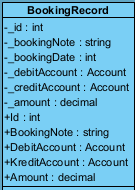 |
| 9.1 | 11 | Starting the application, | Postman | Post on booking/book JWT | Status Code 401: Unauthorized |
| 10.1 | 12 | Docs open. | Docs | Look at the UML paragraph. | UML is shown in the docs. |
| 11.1 | 13 | Docs open. | Docs | Look at the doc language | Language is English |
| 12.1 | 14 | Docs open. | Docs | Navigate to glossary | A glossary contains translations and explanations |
Testenvironment
Microsoft Visual Studio Enterprise (VS)
- Microsoft Visual Studio Enterprise 2022
- Version: 17.9.1
- VisualStudio.17.Release/17.9.1+34616.47
- Microsoft .NET Framework: Version 4.8.09032
- Installed Version: Enterprise
- C# Tools: 4.9.0-3.24081.11+989117396f26e5453ff157df610d22ce45b6b0a9
- Microsoft JVM Debugger: 1.0
- NuGet Package Manager: 6.9.1
- Visual Studio IntelliCode: 2.2
Visual Studio Code (VSC)
- Version: 1.85.2 (user setup)
- Commit: 8b3775030ed1a69b13e4f4c628c612102e30a681
- Chromium: 114.0.5735.289
- Electron: 25.9.7
- ElectronBuildId: 26354273
- Node.js: 18.15.0
- V8: 11.4.183.29-electron.0
- OS: Windows_NT x64 10.0.22621
- Sandboxed: Yes
Microsoft SQL Server Management Studio 18
- Version: 18.11.1
Chrome (for PDFs und Documentation)
- Version 122.0.6261.58 (Official Build) (64-bit)
Visual Paradigm
- Version: 17.1
Decide
Database Type and Engine
At the very beginning of the project we were thinking about using a realtime NoSQL database such as Firebase to avoid having to deal with failed transactions. That would have worked by attaching observers to certain nodes (JSON elements) in the database and subscribing them to update events.
However, we decided to go with a relational database in the end, so that we can avoid redundancy. Our final decision on this subject came down to Microsoft SQL Server 2022 Express. We chose that engine due to its range of feature and our experience with it.
Production Database Hosting
Initially, we thought that we could simply spin up a database with our student accounts on Microsoft Azure, the pricing however, turned out to be very inconvenient. For our use case it was way too expensive and this option was out of question in no time after we found out about that.
After looking for an alternative host for Microsoft SQL Servers, one of our team members was kind enough and offered to host the database privately on his own server at home. So after setting things up and forwarding the port of the SQL server, the database was ready for use.
Development Database Options
For development and testing purposes we decided to use a secondary database with fake data on it to be able to swiftly reproduce scenarios and different use cases without potentially breaking the main production database. That secondary database should consist of a docker container with a docker image that already has the fake test data in it. This way we can just reset everything when restarting that container if it has impersistent storage.
Documentation Site
In terms of hosting the documentation there were interesting discussions as well. They were mostly about whether we should stay with Docusaurus (a technology we all know from previous projects) or if we should try out something new as an alternative. This is due to Docusaurus being a struggle to fully integrate and automate with GitHub-Pages.
As a replacement we found several other tools. Most of them were sadly even less convenient or just overly complicated compared to docusaurus. One of the top candidates was Sphinx, but it uses a very odd syntax over the regular Markdown everyone in the team is used to.
When looking for a potential host for it we found Read the Docs. It can even fully automate previews and deployments from a GitHub repository by simply setting up a Webhook in it. This feature spared us the creation of a dedicated workflow and the debugging of it, which took a good while with Docusaurus originally. So this is the host we went with for the documentation, instead of GitHub-Pages.
While skimming through the documentation of the new host, we found out that it also works with a Markdown based framework called MkDocs. After reading up a bit on MkDoc's customization possibilities we found the Material Theme for MkDocs by Squidfunk to be suitable for our needs. It provides more or less the same features as Docusaurus, just without the complications we had. As so, our final decision regarding the documentation side of things was to use MkDocs with the Material Theme and host it on Read the Docs.
Linting and Linters
When it comes to linting C#, dotnet has a default formatter that can also enforce some style rules and patterns. The range of options one can choose from is not very wide, however. To have more freedom in terms of details and choice, we decided to integrate stylecop, a static code analyzer for C#, into our project.
REST API Framework
So we won't have to create our entire REST API from scratch, we decided to use a framework that is part of the dotnet ecosystem. We will be using an ASP.NET Core Web API to get things going.
Another reason for our choice was the compatibility and easy integration with the Entity Framework
Testing REST Endpoints
To test and develop the endpoints of the REST API we will be using a workspace on Postman. It is a tool that supports automated testing of API endpoints with lots of utility. The reason we went with this option is that all of us worked with it several times before.
Handling SQL Transaction Errors
Considering the fact that our app will be booking digital money, we want rule out any possibility of anomalies that can alter the total amount of money in the system. Especially since our app allows multiple users to use it at the same time.
We put these measures into place to handle conflicting transactions:
- avoid common columns by calculating total with past records (no common writes)
- queue record requests for compatibility check (warning/error can be raised)
Realise
Achitecture
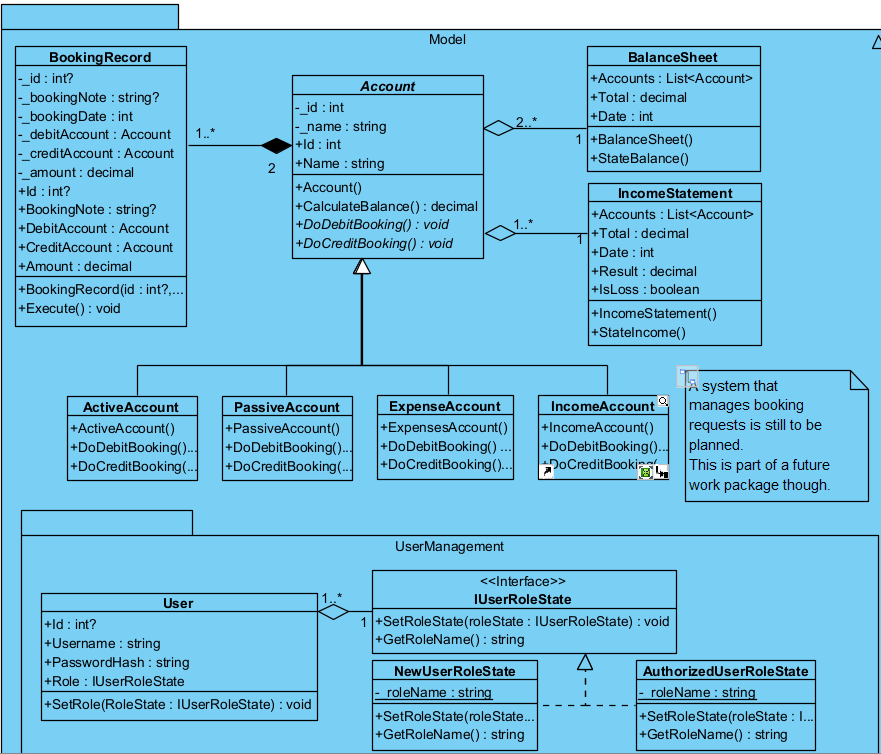
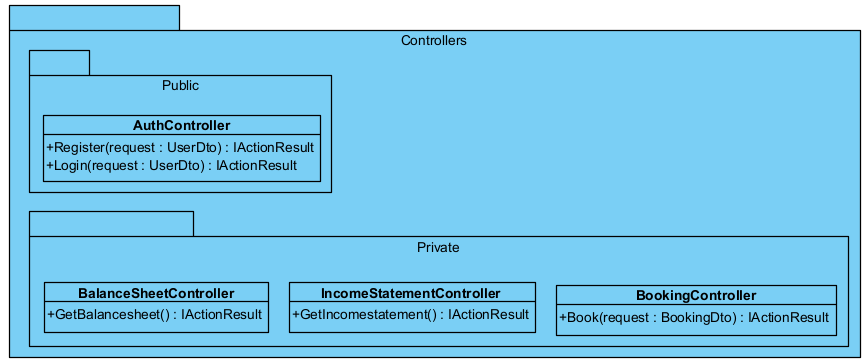
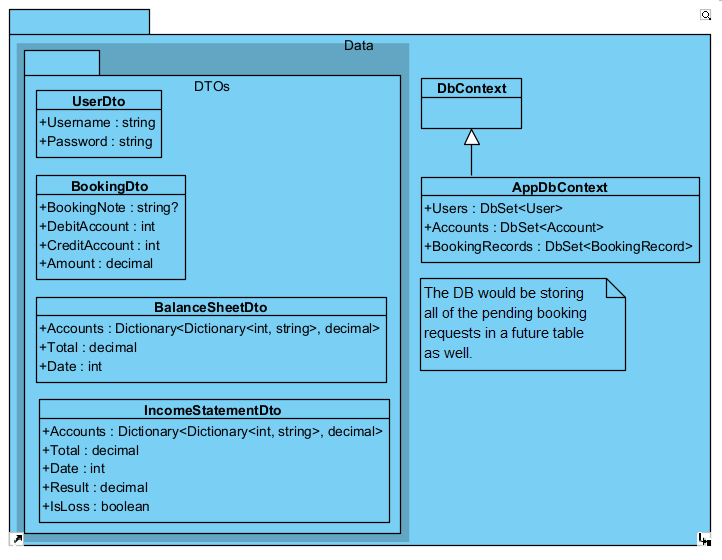
Before implementing the project, the first step was to work out an architecture for it. All group members had to have the same idea of the things they should implement and how. A UML class diagram seemed like the ideal tool to us for this use case. Below you can find the simplified version of the architecture as a UML class diagram. Please note that it does not represent the code in the code base directly, it simply served as means of orientation when programming.
Execution Table
Execution Table
This is the table that shows the actual time it took to fully implement the project.
| Nr. | Due Date | Description | Actual Time | Estimated Time (45 min.) |
|---|---|---|---|---|
| 0 | 25.01.2024 | Create table with work packages | 2 | 2 |
| 1 | 18.01.2024 | Set up documentation | 5 | 5 |
| 2 | 18.01.2024 | Set up project | 3 | 3 |
| 3 | 18.01.2024 | Set up repositories | 2 | 2 |
| 4 | 18.01.2024 | Define detailed requirements | 2 | 2 |
| 5 | 01.02.2024 | Set up shared (prod.) DB (with users) | 5 | 7 |
| 6 | 25.01.2024 | Research Technologies | 5 | 5 |
| 7 | 25.01.2024 | Create detailed MVC class diagram in VP | 20 | 15 |
| 8 | 25.01.2024 | Decide about technologies to use | 3 | 3 |
| 9 | 25.01.2024 | Set up test DB (with users) | 5 | 5 |
| 10 | 25.01.2024 | Set up linter and styling rules | 3 | 3 |
| 11 | 01.02.2024 | Set up CI pipelines | 3 | 5 |
| 12 | 01.02.2024 | Set up pre-commits | 3 | 3 |
| 13 | 01.02.2024 | Write test cases for every requirement with test env. definition (documentation) | 12 | 8 |
| 14 | 01.02.2024 | Write unittests from test cases (for model only!) | 7 | 6 |
| 15 | 25.01.2024 | Integrate EF as ORM with DB | 5 | 5 |
| 16 | 25.01.2024 | Create class and method bodies from class diagram | 2 | 2 |
| 17 | 22.02.2024 | Implement registration endpoint | 2 | 2 |
| 18 | 22.02.2024 | Implement login endpoint and authorization | 3 | 4 |
| 19 | 22.02.2024 | Implement booking record (request) creation with a queue | 5 | 2 |
| 20 | 22.02.2024 | Implement balance sheet generation | 3 | 3 |
| 21 | 22.02.2024 | Implement income statement generation | 3 | 3 |
| 22 | 29.02.2024 | Implement pending record request processing | 4 | 5 |
| 23 | 29.02.2024 | Run tests and create protocol with a conclusion of the run | 3 | 2 |
| 24 | 29.02.2024 | Evaluate results of the project (as a group) | 2 | 3 |
| - | - | Total estimated time effort in lessons: | 112 | 105 |
Some of the tasks took longer to implement than thought. The additional time was accounted for voluntarily outside of school hours.
Control
Test Protocol
| Test-Nr. | Note | Result | Date | Signature |
|---|---|---|---|---|
| 1.1 | No tests with for multiuser functionality | NOK | 07.03.2024 | Marton Naray |
| 2.1 | OK | 07.03.2024 | Marton Naray | |
| 3.1 | OK | 07.03.2024 | Marton Naray | |
| 4.1 | AppDbContext can't inject reference to EFDataRepository into new accounts from db. This causes a null reference to the DataRepository in the Accounts. | NOK | 07.03.2024 | Marton Naray |
| 5.1 | AppDbContext can't inject reference to EFDataRepository into new accounts from db. This causes a null reference to the DataRepository in the Accounts. | NOK | 07.03.2024 | Marton Naray |
| 6.1 | AppDbContext can't inject reference to EFDataRepository into new accounts from db. This causes a null reference to the DataRepository in the Accounts. | NOK | 07.03.2024 | Marton Naray |
| 7.1 | OK | 07.03.2024 | Marton Naray | |
| 8.1 | OK | 07.03.2024 | Marton Naray | |
| 9.1 | OK | 07.03.2024 | Marton Naray | |
| 10.1 | OK | 07.03.2024 | Marton Naray | |
| 11.1 | OK | 07.03.2024 | Marton Naray | |
| 12.1 | OK | 07.03.2024 | Marton Naray |
Conclusion
The Unittests are passing, however the Endpoints are not in a usable state as of the this test run. The issue is known and mentioned in the notes of the tests regarding it. This affects the overall quality of the product. It could not be shipped before patching if there was a real client.
Evaluate
The project went smoothly, especially the planning phase. Some issues came up along the way, yet we managed to take care of most of them. A mistake in our code was found during the testing phase, by when it was already too late to correct it. If there was another iteration, it could be fixed, however.
The flow of work and communication was seemingly flawless as well, due to the usage of previous experiences we made as a team in former projects. Said projects often had issues concerning these aspects.
Overall the team agrees on this project being a success. Different concepts and techniques could be passed between the members, as everyone was able to learn something.